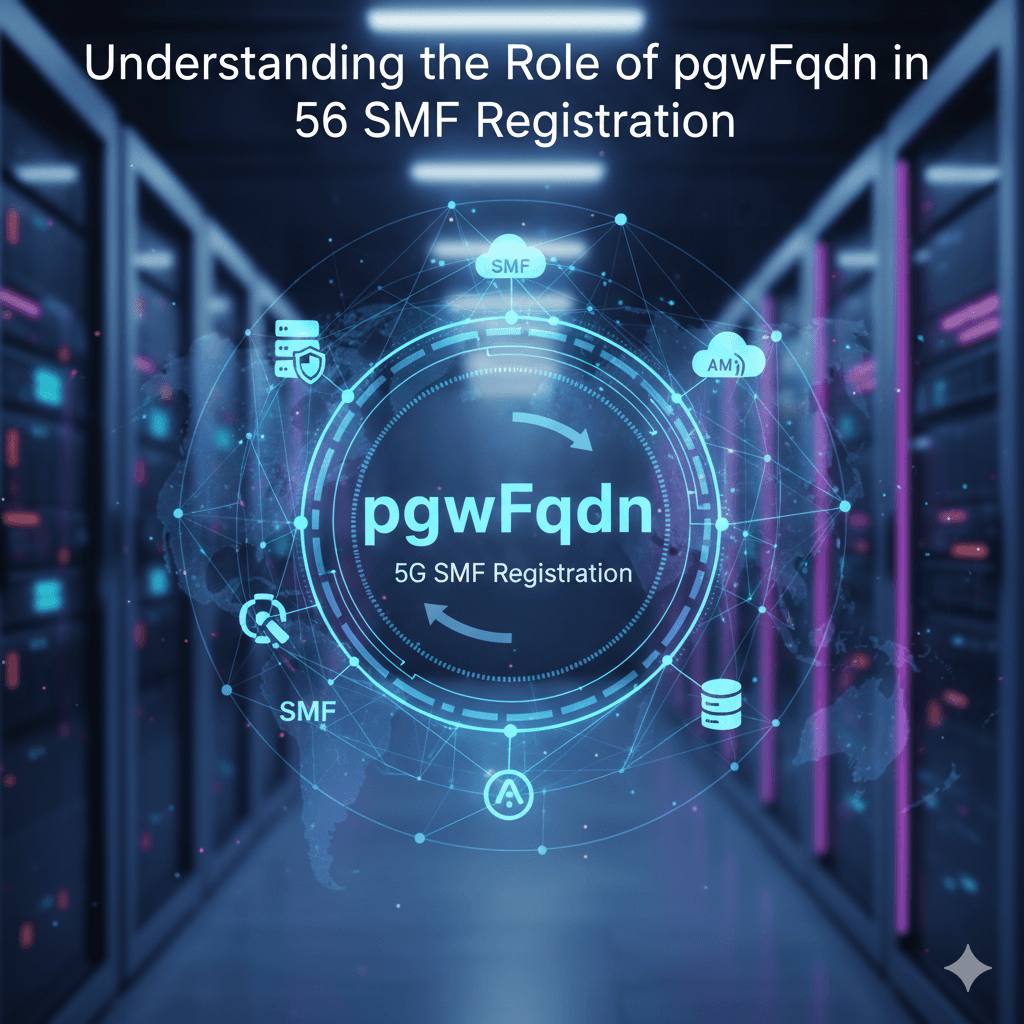
Understanding the Role of pgwFqdn in 5G SMF Registration
Oct 21, 2025
|
5
min read
Introduction
While exploring how EPC and 5GC interwork, I came across something that seemed minor at first — the pgwFqdn field in the SMF registration process.
It turns out this little field plays a key role when the SMF also acts as a PGW-C (PDN Gateway Control Plane) to support mobility between 4G and 5G networks.
Why pgwFqdn Exists
When an SMF registers with the NRF (Network Repository Function), it normally shares its service details and endpoints.
If the SMF also supports EPC interworking, it includes pgwFqdn — the PDN Gateway Fully Qualified Domain Name.
This FQDN serves as a bridge between the EPC world (which still sees a PGW-C) and the 5G Core world (where we have the SMF).
It allows other network functions, like the AMF or MME, to locate the same SMF instance during interworking scenarios.
How It Works in Real Life
Imagine a user streaming video while connected to a 4G network through the EPC.
When the user moves into 5G coverage, the device connects via the AMF.
The AMF then queries the NRF using the pgwFqdn to find the same SMF that was handling the user’s session in 4G.
As a result, the session continues smoothly — no drops, no interruptions.
Behind the scenes, this happens because both cores can identify and coordinate through that single field.
When It’s Used
In pure 5G deployments, you’ll never see this parameter — there’s no EPC to talk to.
But in interworking setups where EPC and 5GC coexist, pgwFqdn quietly ensures the continuity of user sessions and mobility between the two cores.
Final Thoughts
The more I explore these details, the more I appreciate how thoughtfully 5G was designed.
Something as small as a single FQDN field can make the difference between a seamless handover and a dropped session.
It’s another reminder that in telecom, even the smallest parameters can carry big responsibilities.
#5G #Telecom #5GCore #SMF #EPC #Networking #TelecomEngineering #Interworking #AMF #MME #NRF #Mobility